
ride info
getting there
Ride Start Locations
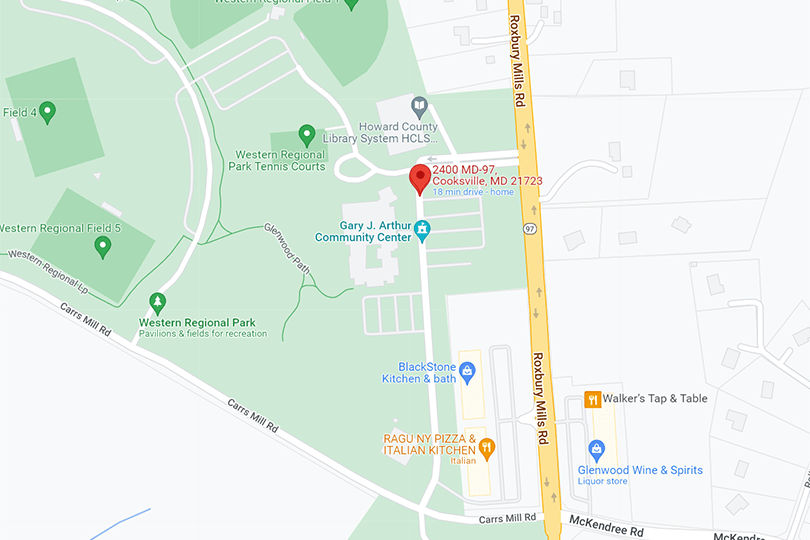
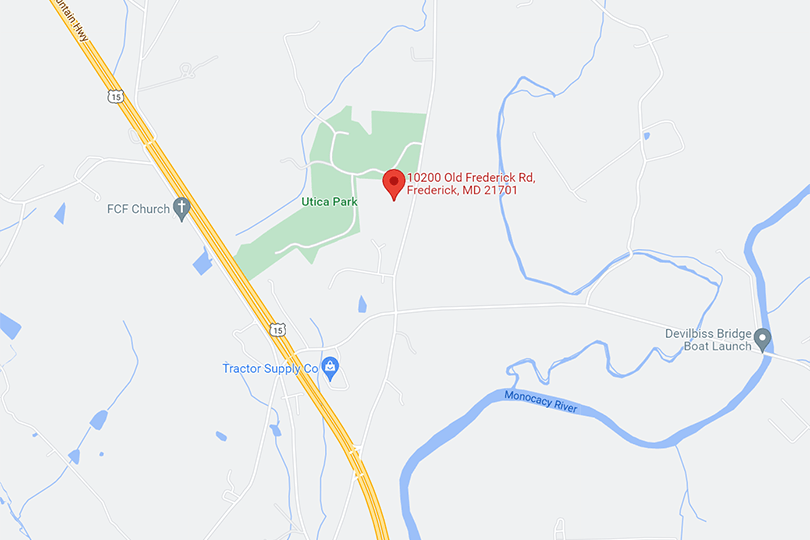
During the warm months, we offer midweek rides, starting and ending at the Gary J. Arthur Community Center, in Glenwood, Md. We also occasionally host weekend rides from Utica Park, in Frederick, Md. During the winter, we offer midweek paved trail rides in the Columbia, Md., area. Select the maps at the right for directions, and visit our Calendar page for ride times and routes. Also, members have access to the club’s Ride With GPS route library.
Community Center
Utica Park
Ride Paces
Our midweek rides are divided into groups (below) to accommodate riders of all skill and experience levels. We provide a Road Marshal (sweep) for the Supported group to help slower riders along and share tips on riding etiquette and safety. Also: See our Safe Cycling page for guidance on group ride etiquette.
Spirited
A: 17+ mph
(Long route only) This group typically will average at least 17 mph (often higher) and not regroup, and it often will form pacelines. Riders will need to work hard on hills to keep up and might be dropped. Riders should be self-sufficient and able to navigate independently. All riders must be experienced in the etiquette, skills, and communications of group cycling. If you do not have experience with pacelines and fast groups, then no matter how strong you might be, do not join this group to learn those skills.
Moderate
B: 14-16 mph
(Short and long routes) The average pace of this group, often our largest, tends to vary widely, with some riders pushing the pace—sometimes hard—and others simply riding briskly. This group is a good fit for riders who want to get faster and/or develop better group riding skills, such as riding in a paceline. Rides might not regroup, so riders should be able to navigate independently and perform minor repairs. All riders should be experienced in group ride etiquette and communication (e.g., “car back,” “walker up”).
Chill & Chat
C: 11-13 mph
(Short and long routes) A social ride at a pace that allows for conversation and will sometimes regroup. All riders should be familiar with ride etiquette and communication (e.g., “car back,” “walker up”) and be prepared to navigate independently and handle minor on-road repairs. We highly recommend that those new to group rides participate in the Supported group once or twice before selecting this category.
Supported
D: 8-10 mph
(Short route only) For riders new to group rides or who simply prefer a slower pace. Riders in this category should be able to complete a ride of about 20 miles. This ride has a Road Marshal, or “sweep”—i.e., a more experienced rider who will accompany the slowest rider. The sweep might offer riding and safety suggestions, but do not expect the sweep to be an on-the-road mechanic! The sweep might suggest that a rider return early or take a bail out route if they determine it is in the rider’s best interest.
Weather Cancellation Policies
We err to the side of caution when deciding whether to cancel a ride. We all want to ride but only under the safest conditions. All ride cancellation decisions are done in the best interest of all riders and considered final. Of course, riders may ride at their own risk if the official ride is canceled, but it will not be considered an official HoCo Cyclists club ride.
Spring/Summer/Fall Ride Cancellation Policy
- If the roads are wet one hour before the start of the ride, it will be canceled and, at the club’s discretion, rescheduled.
- If it rains at any time during the day of the ride, it might be canceled and, at the club’s discretion, rescheduled.
- If the weather forecast the day of the ride calls for a precipitation chance greater than 60 percent at any point during the ride or high wind warnings have been issued, the ride might be canceled and, at the club’s discretion, rescheduled.
- Ride cancellation notices will be distributed by email at least three hours before ride time on the day of the ride.
Winter Trail Ride Cancellation Policy
- If the trails are wet or icy, the ride will be canceled.
- The ride might be canceled if 48 hours has not passed since the most recent rainfall, especially early in the fall.
- If temperatures go into the low 20s or below, the ride might be canceled.
- If it snows within 48 hours prior to the ride, it might be canceled. The Columbia Association (CA) does plow the paths but stops at Lake Elkhorn, where the county takes over responsibility. CA typically takes 48 hours to clear the paths, but there is a needed drying period after that.
- If the weather forecast the day of the ride calls for a precipitation chance greater than 60 percent at any point during the ride or high wind warnings have been issued, the ride might be canceled.
- Ride cancellation notices will be disributed by email by 2 p.m. on the day of the ride.
Frequently Asked Questions
On which side of the street do I ride?
When riding a bicycle on the road, you are considered to be a vehicle. Always ride in the same direction as other vehicles—on the right side of the road.
Where do I park my car for the midweek rides?
Ample parking is available at Gary J. Arthur Community Center for Wednesday’s midweek rides. We usually meet in the lot on the south end of the center. Please be respectful, responsible, and, most important, careful of other cars and fellow cyclists. Parking for Columbia trail rides and weekend rides is available at their respective ride start locations.
Should I take my car keys with me?
It is always a good idea to secure your car and keep the car keys with you during the ride.
How do I download the routes and cue sheets before the ride?
Members can access and download GPS files, PDF route maps, and cue sheets from the calendar listings on this site. If you have a compatible device (e.g., Garmin Edge, Wahoo ELEMNT, etc.) you can transfer the GPS file directly to the device. Alternatively, you can print the PDF routes and clip them to your bicycle.
Do I need front and rear lights?
For maximum safety, we strongly recommend front and rear marker lights, even during daytime rides.
How do I contact someone in the club if I get lost or have bicycle issues?
A HoCo Cyclist board member or another representative will always be onsite for rides and easily identified (they’ll distribute sign-up sheets, announce the start of the ride, etc.). Please ask them to share their contact information before you begin the ride.
Do I need a helmet?
Yes.
Do I need a mirror?
While this is a personal preference, experienced riders strongly encourage using a mirror to improve safety by more easily identifying other cyclists and vehicles approaching you from the rear.
Can I use my mobile phone while riding?
We STRONGLY discourage using a mobile phone while riding, as it could place your fellow riders at risk. If you need to use your phone, first indicate you intend to stop and move safely out of the path of other cyclists and vehicles. For our weekend rides, the group will slow its progress until you catch up.
I am out of shape—can I handle these rides?
We do not race. We ride. Our “newbie” group routes and speeds are specifically selected to encourage all to enjoy. Over time, most cyclists advance to the C level and beyond.
Should I bring water bottles?
Most riders bring at least one water bottle—many bring two—to ensure proper hydration, even in cooler months.
Do you ride in the winter months?
During the winter, the club offers midweek rides on the network of trails in the Columbia area. Individual members also might organize non–club sponsored weekend rides and share details through the club mailing list. Be aware of the need for proper winter clothing.
Do you stop for a rest during the midweek rides?
No. However, individuals are free to do so, as long as they are aware of time, to avoid riding back in poor light.
Do you stop for a rest during weekend rides?
It depends. For shorter rides (less than 30 miles), we usually don’t. For longer rides, we generally have a planned stop every 20 to 25 miles. This allows riders to fill up their water bottles, eat, and rest before the ride resumes.
Do I need a club jersey to ride with the club?
No. But most of us have one to support the club and usually wear them on weekend rides or for other planned events, such as the Back Roads Century, Bike Virginia, etc. This makes it easy for club members to find each other in crowded environments.
How often should I check the air in my tires?
Before every ride. Air pressure will decrease after each ride. Low pressure makes tires susceptible to punctures.
How often should I service my bicycle?
It depends on how much you ride, but at least once a year. You want to ensure your cables, brakes, tires, chains, shifters, and other components are safe and working as required.
How often should I clean my chain?
The general rule is every 100 miles. Most of us do so every two to three rides to remove road grime and ensure an easier, quieter, and safer ride. Your chain also will last longer.
Should I say or do something if I am slowing down or about to stop?
Absolutely, yes. This is very important to avoid accidents. Please say out loud your intention to do so and gradually slow or stop. Use hand gestures, as well, to indicate to those behind you that you intend to stop.
What does it mean to “maintain your line”?
This means that you ride in a straight line as opposed to deviating too much. Maintaining your line makes it easier for the bikers behind you to trust and anticipate your movements, making a safer ride for all.
 HoCo Cyclists